A-Z List | Accessible Info | Careers | Contact Us

 
Images from Peel Region

Toddlers & Preschoolers

Play, Learning and Development

Importance of Play

Importance of play

Toddlers and preschoolers love to help you with everyday activities. Let them help you sweep the floor, count items at the grocery store, and get themselves dressed. Build play into these everyday activities (and more) and you'll help your child become the healthiest, happiest, and most successful person they can be.

As a parent, you are your child's very first and most favourite playmate. The following are guiding principles parents can use when deciding on activities for their toddler/preschooler:

  • Allow your toddler to have at least 30 minutes of structured play, through out the day. Once he becomes a preschooler, plan for at least 60 minutes of structured physical activity every day.
  • Allow your toddler/preschooler to have at least an hour of unstructured physical activity every day. Your child should not be inactive for more than an hour at a time, except when sleeping.
  • Encourage your toddler or preschooler to move in all kinds of ways. Those movements are building blocks that will allow him to develop more complex movements.
  • Set up indoor and outdoor areas that meet or exceed recommended safety standards in which your toddler or preschooler can perform large muscle activities.

Know that your toddler or preschooler needs to be physically active. It is essential for his well-being.

Ways to play:

12-18 months

Your child will begin to:

  • Run, kick a ball, ride on small-wheeled toys, squat when playing.

You can:

  • Allow your baby to play with food and utensils. This helps him to learn and also make meal times fun!
  • Dance to music and use riding toys with your child.
  • Play "Follow the Leader" or "Simon Says" and other action games with your child.
  • Read to your child every day, change your voice, talk about the pictures and use puppets and stuffed animals to make book time fun.
  • Provide encouragement during play - you'll be rewarded with smiles and laughs.

| back to top |

18 months to 2 1/2 years

Your child will begin to:

  • Walk upstairs and downstairs, climb over furniture, jumps with two feet off the ground, walks backwards and sideways.

Playing with your child helps your child grow and develop!

You can:

  • Encourage your child to talk as you play together. Ask your child to repeat words that you say. Name items around the house and at the grocery store. You can help build language skills every single day!
  • Pretend play with your child. Use old clothes, handbags and shoes to make believe. Role playing is a great way to help your child explore and express her feelings.
  • Stimulate your child's sense of touch by letting her feel items with different textures (e.g. velvet, sand paper, peach fuzz, pine cones and more). Sensory play is important at this age. Be creative! Ask your child to describe the feel of each item (soft, fuzzy, scratchy, etc.).

2 1/2 to 3 1/2 years

Your child will begin to:

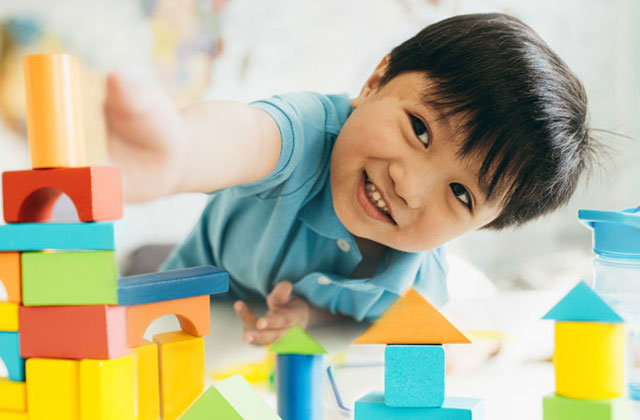
  • Build and create activities using blocks or cardboard boxes.

You can:

  • Use common, inexpensive household materials to do crafts together.
  • Collect and use egg cartons, pie plates, paper towel rolls, old wrapping paper, popsicle sticks, used envelopes and buttons to make crafts and sculptures.
  • Get messy - splash in water, clay, or mud, which are favourties for this age.
  • Try counting around the house or at the grocery store to build play into everyday activities.

| back to top |

3 1/2 to 4 1/2 years

Your child will begin to:

  • Climb on jungle gym, stand on one foot, ride a tricycle, throw a ball, hop.
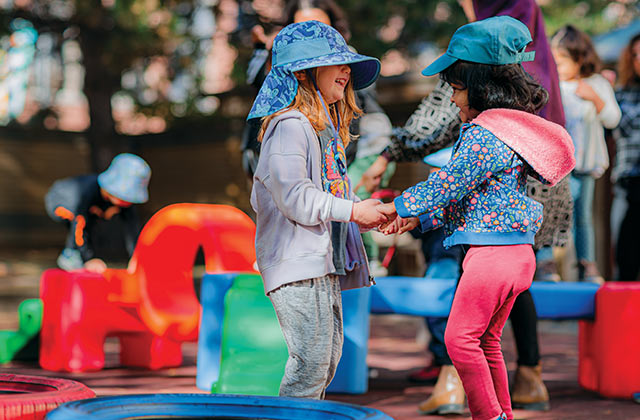
  • Run, jump, play and climb. Children at this age have lots of energy - use it! It will help keep you healthy too.

You can:

  • Spend time together outdoors every day. Explore trees, fallen leaves, grass, snow and puddles.
  • Use books, language games and story telling to increase your child's verbal skills.
  • Encourage your child to create their own stories and sing silly songs. Share stories about your day.
  • Build with cubes, do puzzles and play memory games.

4 1/2 to 6 years

Your child will begin to:

  • Throw and catch a ball, balance on a beam, gallop, toss beanbags into holes, and skip.

You can:

  • Ask your child to help you with tasks around the house and thank him for being such a good helper.
  • Be creative - make crafts with objects from around the house.
  • Play with letters and numbers to teach children skills they need for school.
  • Ask your child to spell or write their name. This gives your child confidence.
  • Cook with your child to build play into everyday activities. Use the opportunity to talk about healthy food choices.
  • Play board games like snakes and ladders, card games and team sports are all games that help your child learn to take turns, negotiate, problem-solve and get along with others. Games with rules become a part of play for children 4 1/2 to 6 years old.

| back to top |

For more information:

Region of Peel - Public Health
905-799-7700
Monday to Friday 8:30 a.m. to 4:30 p.m.
to speak with a Public Health Nurse

Caledon residents call free of charge at 905-584-2216


Nutrition | Play, Learning and Development | Safety | Behaviour
Sleep | Childhood Illnesses | Child Care | Contact Us

Revised: Thursday August 26 2010

www.peelregion.ca

Home | Contact Us | Search | A-Z Topic List
Privacy & Terms of Use | Service Commitment

Smaller Text Larger Text